
Average Cost for a Crown on a Molar by Material and Region
A crown on a molar typically costs between $800 and $2,500, with the average single permanent crown in the United States priced at $1,369 in 2026. In the UK, private clinic pricing usually sits between £500 and £900, while Australian dental fees average AUD 1,200 to AUD 2,500 per unit. These figures vary because geographical location and custom dental laboratory fees heavily drive the baseline cost. Restoring a damaged molar requires high-strength materials and skilled lab technicians who can craft a restoration that withstands hundreds of pounds of pressure per square inch.
Understanding the Base Cost for a Crown on a Molar
Across North America and overseas, cash rates vary dramatically based on overhead, materials, and regional living costs. In the United States, state averages range from $1,046 in Alabama up to $2,331 in California. Patients often use tools to estimate dental crown expenses before walking into an operatory. If you live north of the border, reviewing local pricing for crowns in Ontario will give you a clearer picture of provincial fee guide standards compared to broader global averages.
Crown Material Types, Longevity, and Price Comparison
The specific restorative material you choose directly impacts both your immediate out-of-pocket invoice and the restoration’s lifespan. Molars demand materials engineered for strength above pure translucency.
| Crown Material | Typical US Cost Range | Expected Lifespan | Aesthetic Quality | Best Clinical Application |
|---|---|---|---|---|
| Monolithic Zirconia | $1,000 – $2,500 | 10 – 20+ Years | Good (Tooth-Coloured) | Heavy bruxism, high-load back molars |
| Porcelain-Fused-to-Metal (PFM) | $800 – $1,800 | 8 – 15 Years | Fair (Metal margin risk) | Budget-friendly posterior support |
| Full Gold / Cast Metal | $900 – $2,500 | 15 – 30+ Years | Low (Metallic finish) | Second molars, minimal tooth prep |
| Lithium Disilicate (E-Max) | $1,100 – $2,200 | 10 – 15 Years | Excellent (Highly Natural) | Premolars, front-facing restorations |
A 2026 systematic review of 64 clinical studies demonstrated that monolithic lithium disilicate crowns achieve a 98.5% five-year survival rate. However, monolithic zirconia remains the modern gold standard for posterior teeth because it is virtually fracture-proof against aggressive chewing. Looking closely at the long-term durability of dental crowns helps patients see why spending slightly more on premium zirconia or cast gold saves money on replacements down the road.
Why Back Molars Cost More Than Front Teeth
While anterior (front) teeth require extensive shade matching to blend seamlessly into your smile, back molars present unique clinical challenges. Mastication forces reach peak intensity at your first and second molars, demanding thicker restorative walls, superior raw materials, and precise occlusal adjustments.
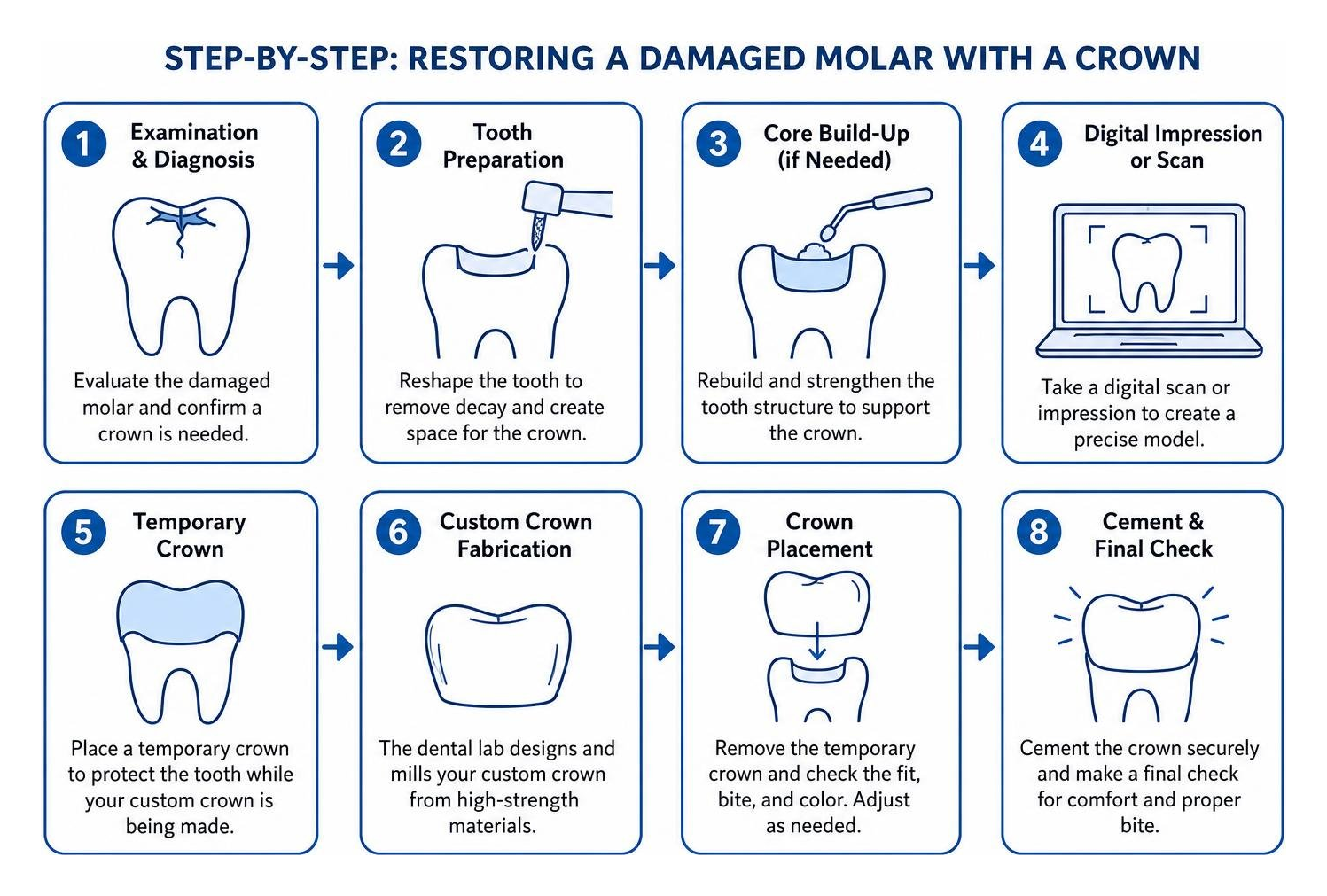
Second molars sit in tight, hard-to-reach areas of the mouth where saliva control, digital scanning, and tooth reduction require advanced dexterity. Fabricating crown and bridge restorations for these teeth often incurs higher laboratory charges due to the specialized high-strength milling blocks required.
Additional Procedures: Hidden Fees That Increase Total Treatment Cost
A common misconception is that the fee on a quote covers the entire restorative appointment from start to finish. In reality, teeth that need full-coverage caps often have deep structural damage that requires preparatory work before a permanent crown can seat safely.
Diagnostic periapical X-rays, local anesthesia, temporary crowns, and final cementation are often bundled into the base fee, but foundational structural work is billed separately under distinct procedure codes. Reviewing an independent guide on back-tooth crown expenses can help you identify these supplementary line items early.
Core Buildup and Post-and-Core Rebuilding
When decay consumes a large portion of a molar, not enough healthy natural enamel remains to anchor a crown. Dentists must place a core buildup—reconstructing the missing interior with specialized composite resin.
- Core Buildup: Adds $150 to $450 to the final bill.
- Prefabricated Post and Core: Adds $200 to $500 when structural retention is severely compromised following a root canal.
Without a solid core buildup, the crown has nothing stable to grip, leading to early dislodgement or catastrophic fracture below the gumline.
Root Canal Therapy Before Crown Placement
If bacteria penetrate the inner pulp chamber of your tooth, a crown alone cannot resolve the underlying infection. Endodontic therapy must clean, disinfect, and seal the root canals before final crown fabrication.
Molars feature complex anatomy, typically housing three or four distinct canals. Reviewing standard root canal procedure fees alongside available endodontic therapy options reveals that treating multi-canal teeth adds $700 to $1,500 before the buildup and crown are placed. Combined, a root canal, core buildup, and crown easily turn into a $2,000 to $3,500 multi-stage project.
Crowns vs. Inlays, Onlays, and Large Fillings
We always practice conservative dentistry whenever possible. A standard composite resin filling works well when the majority of natural tooth structure remains intact. However, once decay undermines one or more cusps, an oversized filling acts like a wedge, splitting the remaining tooth under heavy bite loads.
An onlay (often called a partial crown) covers only the damaged cusps while preserving healthy enamel. If more than 50% of the clinical crown is compromised or the tooth has undergone endodontic treatment, a full-coverage crown provides the 360-degree protection needed to prevent permanent structural loss.
Insurance Coverage, Medicaid, and Out-of-Pocket Payment Rules
Navigating dental benefits can feel overwhelming, but understanding how claims processors classify major procedures helps eliminate billing surprises.
How Insurance Plans Affect the Cost for a Crown on a Molar
Standard dental PPO plans classify dental crowns as “Major Restorative” care. Under standard 100/80/50 coverage models:
- Preventative cleanings are covered at 100%.
- Basic fillings are covered at 80%.
- Major crowns are covered at 50% after you meet your deductible.
If a molar crown costs $1,400 and your deductible is $50, your insurer pays approximately $675, leaving you with an out-of-pocket balance of $725. Keep a close eye on your annual maximum—which typically caps total yearly payouts between $1,000 and $2,000.
Watch out for alternate-benefit or downgrade clauses. If you select an all-ceramic or zirconia crown on a back molar, your insurer may downgrade the claim reimbursement to the fee of a basic porcelain-fused-to-metal or base-metal crown, leaving you responsible for the price difference.
Public Programs: Medicare, Medicaid, and Government Dental Benefits
In the United States, standard Medicare excludes routine and major dental work entirely, though select Medicare Advantage (Part C) plans offer partial allowances.
State Medicaid programs vary widely for adult dental benefits. Nationwide, Medicaid programs that do cover adult crowns reimburse an average of $546 per claim line—substantially below private market rates. Because of this gap, roughly 20% of private practice dentists bill Medicaid, and coverage for posterior molars is frequently restricted strictly to non-precious metal or stainless steel caps unless acute medical necessity is proven.
Affordable Alternatives and Financing Strategies for Molar Crowns
If you do not have private dental benefits or your annual maximum is exhausted, several practical strategies can help reduce your out-of-pocket expenses:
- University Dental Clinics: Accredited dental schools offer treatments completed by senior students under close faculty supervision, typically reducing fees by 40% to 60% ($400–$800 per crown).
- In-House Dental Membership Plans: Many private clinics offer annual membership programs that provide 15% to 25% discounts on major restorative procedures with no waiting periods or claim caps.
- Health Savings Accounts (HSA) & Flexible Spending Accounts (FSA): Paying with pre-tax dollars effectively saves you 20% to 35% depending on your personal tax bracket.
- Promotional Healthcare Financing: Programs like CareCredit or in-office payment plans frequently offer 6- to 12-month 0% APR financing options, allowing you to split a four-figure procedure into manageable monthly payments.
- Benefit Year Staging: If you need a root canal, core buildup, and crown toward the end of the calendar year, ask your dentist if the root canal can be completed in November and the permanent crown cemented in January to utilize two separate annual maximums.
Frequently Asked Questions About Molar Crown Costs
What is the average out-of-pocket price for a molar crown with insurance?
With a standard dental PPO plan covering 50% of major restorative treatments, most patients pay between $500 and $900 out-of-pocket for an uncomplicated molar crown. If you require an additional core buildup ($150–$450) or have not yet met your annual deductible, your out-of-pocket total will generally land between $650 and $1,200.
Is a gold crown cheaper or more durable than a zirconia crown on a back tooth?
Full gold alloy crowns generally cost about the same as or slightly more than monolithic zirconia ($1,200–$2,500) due to fluctuating precious metal commodity prices. However, gold remains the most durable material available. It will not fracture, causes virtually zero abrasive wear to opposing natural teeth, and routinely lasts 20 to 30+ years in high-pressure chewing zones.
What happens if I delay getting a crown on a cracked or root-canaled molar?
Postponing a needed crown on a structurally compromised molar leaves it vulnerable to catastrophic vertical root fractures. If the tooth splits down into the root system below the bone line, it cannot be saved with a crown or filling. The only remaining clinical option is extraction, which leaves you facing the significantly higher costs for dental implants ($3,000–$5,000+) or a multi-unit bridge to restore chewing function.
Conclusion
A crown on a back molar is an investment in protecting your natural bite and avoiding complex tooth replacements later on. While the base procedure averages between $800 and $2,500 depending on material and location, diagnostic imaging, core buildups, and root canals can adjust that baseline figure.
At Barton Dental, our family-focused team brings over 20 years of experience to Hamilton, Ontario, providing clear, itemized treatment plans, same-day emergency support, and direct billing for programs like Steelworkers benefits. If you have a damaged, painful, or heavily filled tooth, schedule a consultation for dental crown treatment with us today to protect your smile for decades to come.